
Grab Engineering - Scaling Grab's Data Lake - Our journey to Apache Iceberg adoption
Here is my notes about the blog https://engineering.grab.com/our-journey-to-apache-iceberg-adoption
1. Concepts
| Term | Idea |
|---|---|
| S3 | Stores the actual Parquet files. |
| Hive | Traditional table format. Metadata points to partition folders. |
| Hive Metastore | Stores table → partition → S3 location. |
| Iceberg | Modern table format. Metadata points directly to data files. |
| Snapshot | Current version of a table. |
| Manifest | Metadata describing data files in a snapshot. |
| UnifiedSparkCatalog | Routes Spark requests to Hive or Iceberg transparently. |
2. Main Idea
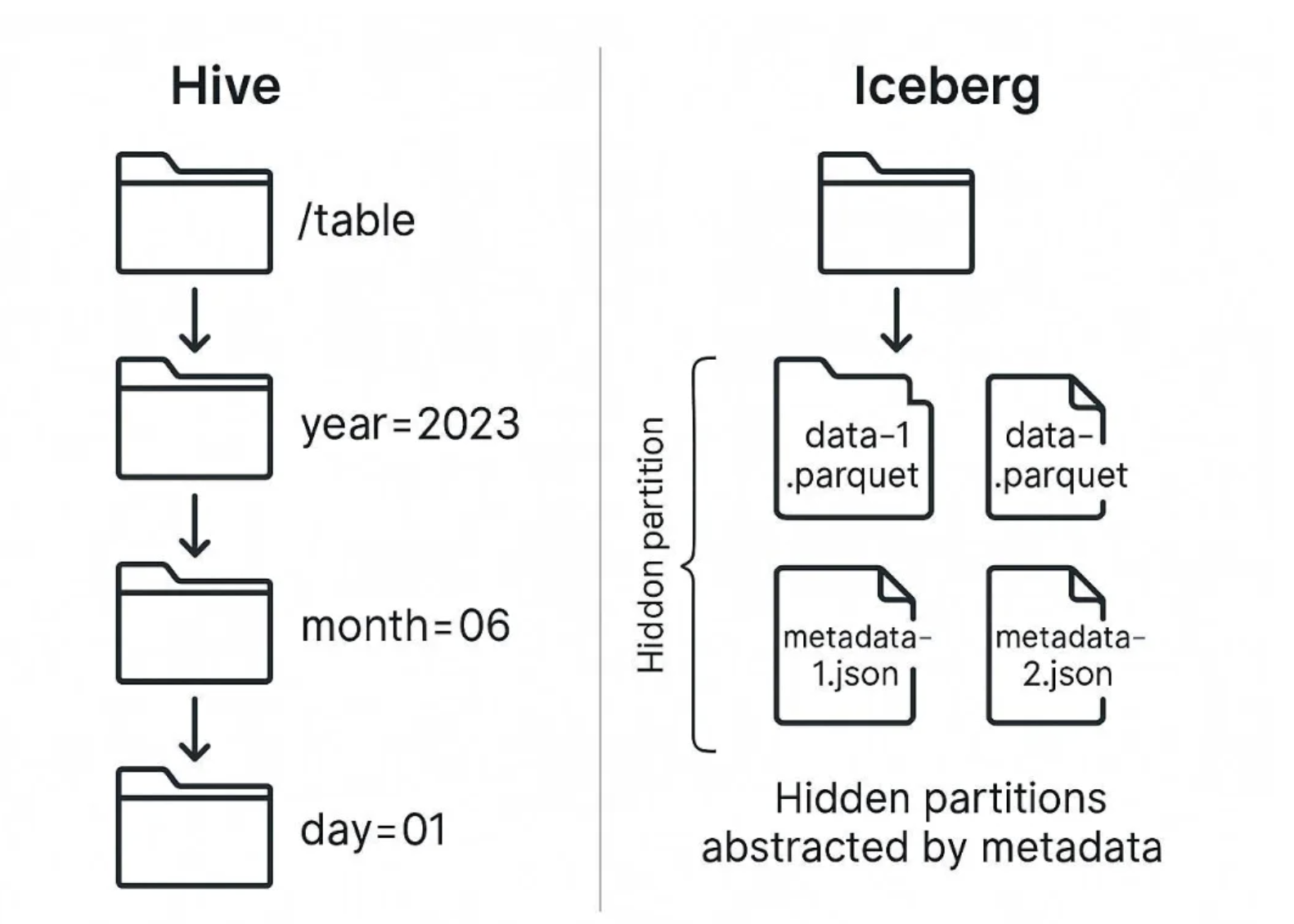
Grab did not replace S3 or Parquet.
They replaced how metadata is managed.
2.1. Before Architecture
Spark
   │
Hive Metastore
   │
Parquet Files on S3
2.2. After Architecture
Spark
   │
UnifiedSparkCatalog
   │
Iceberg Metadata
   │
Parquet Files on S3
3. Why move from Hive to Iceberg?
3.1 Hive folder structure
Hive organizes data by directory partitions.
orders/

├── dt=2026-07-10/
│   ├── part-0001.parquet
│   ├── part-0002.parquet
│
├── dt=2026-07-11/
│   ├── part-0001.parquet
│
└── dt=2026-07-12/
    ├── part-0001.parquet
    ├── part-0002.parquet
    └── part-0003.parquet
Hive Metastore stores something like:
orders

↓

Partition:
dt=2026-07-12

↓

Location:
s3://orders/dt=2026-07-12/
It knows:
- ✅ Partition name
- ✅ Folder location
It does not know
- which Parquet files exist
- row count
- column statistics
- snapshots
- transaction history
When Spark executes
SELECT *
FROM orders
WHERE dt='2026-07-12';
Workflow
Spark

↓

Hive Metastore

↓

Get partition folder

↓

S3 ListObjects()

↓

part-0001.parquet
part-0002.parquet
part-0003.parquet

↓

Read Parquet files
Spark has to discover the files by asking S3.
3.2 Iceberg folder structure
Iceberg no longer relies on partition folders.
orders/

├── metadata/
│   ├── v1.metadata.json
│   ├── snap-100.avro
│   ├── manifest-list.avro
│   └── manifest-001.avro
│
└── data/
    ├── 00001.parquet
    ├── 00002.parquet
    ├── 00003.parquet
    └── 00004.parquet
Notice:
There is no requirement for folders like:
dt=2026-07-12/
Instead, Iceberg metadata knows:
Snapshot

↓

Manifest

↓

00001.parquet
dt=2026-07-12
rows=2M

00002.parquet
dt=2026-07-12
rows=3M

00003.parquet
dt=2026-07-15
rows=2M
Same query
SELECT *
FROM orders
WHERE dt='2026-07-12';
Workflow
Spark

↓

Current Snapshot

↓

Manifest

↓

Read

00001.parquet

00002.parquet
No directory listing.
No searching S3.
Iceberg already knows which files belong to the query.
3.3 Key Difference
Hive
Metadata

↓

Partition

↓

Folder

↓

Discover files
Iceberg
Metadata

↓

Snapshot

↓

Manifest

↓

Data Files
Hive stores where a partition is located.
Iceberg stores which data files exist and metadata about each file.
3.4 Why is Iceberg faster?
The data files are still Parquet.
The storage is still S3.
The speed improvement comes from reducing metadata work.
Hive
Query

↓

Hive Metastore

↓

List S3 folder

↓

Find files

↓

Read data
Iceberg
Query

↓

Snapshot

↓

Manifest

↓

Read matching files
At small scale, the difference is small.
At Grab’s scale (petabytes of data and billions of S3 objects), avoiding S3 directory listings and leveraging rich metadata significantly reduces query planning time and S3 API costs.
4. Why introduce UnifiedSparkCatalog?
During migration, both Hive and Iceberg tables existed.
| Table | Format |
|---|---|
| orders | Hive |
| payments | Iceberg |
| drivers | Iceberg |
Without UnifiedSparkCatalog
SELECT * FROM hive.orders;

SELECT * FROM iceberg.payments;
Every application needs to know the table format.
With UnifiedSparkCatalog
             Spark

               │

    UnifiedSparkCatalog

       /             \

 Hive Catalog   Iceberg Catalog
Applications always execute
SELECT * FROM orders;
Internally
LoadTable("orders")

↓

Detect table format

↓

Hive Catalog
or
Iceberg Catalog
5. Learning Notes
-
Iceberg allow to describe metadata fields of item in manifest.
-
Hive only contains: partition -> s3 address.
-
For big data up to pentabytes -> distributed storage.