



Research about Redis
Here is some research about Redis.
1. Deploy Redis
- Deploy Redis using the Linux operating system
2. Redis Sentinel
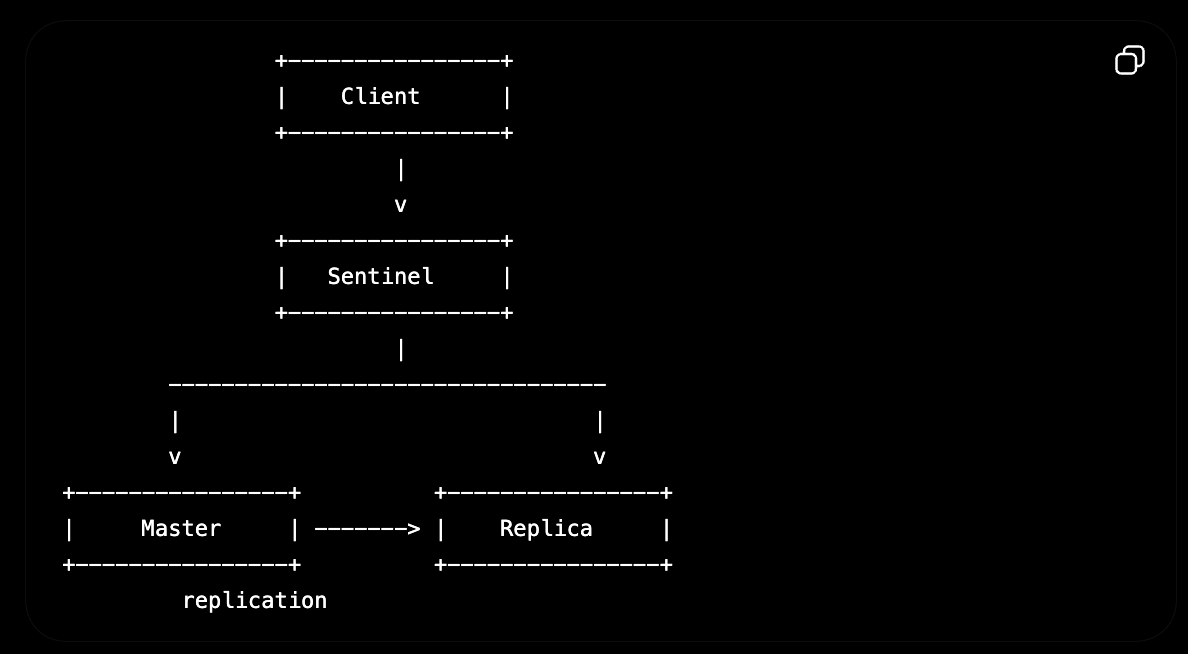
2.1. Redis Senitel
A Sentinel is a special Redis process that:
- monitors Redis servers,
- detects failures,
- performs failover,
- informs clients about topology changes.
Sentinel does not store application data.
Its job is management and monitoring.
2.2. Master
The master Redis server:
- accepts write operations,
- stores the main data,
- replicates data to replicas.
Example: SET user:1 “Alice”
This write goes to the master.
2.3. Replica (slave)
A replica is a copy of the master.
It:
- receives replicated data from master,
- usually handles read requests,
- can become new master during failover.
Example architecture:
        Master
       /      \
  Replica1   Replica2
2.4. Client
A client is the application using Redis.
Examples:
- Java application,
- Node.js backend,
- Python service.
The client can:
- connect directly to Redis,
- or ask Sentinel for the current master address.
Example flow:
Client → Sentinel → “Who is master?” Client → Current
2.5. What is feature of Redis Sentinel
It mainly provides 4 functions:
- Monitoring
-
Watches Redis master and replica instances.
-
Detects whether they are alive and healthy.
- Notification
-
Sends alerts/events when something changes.
-
Example: master goes down, replica disconnects, failover completed.
- Automatic Failover
- If the master fails, Sentinel automatically:
- selects a replica,
- promotes it to become the new master,
- reconfigures other replicas.
- Configuration Provider
-
Clients can ask Sentinel: “Who is the current master?”
-
Useful because master may change after failover.
2.6. What is quorum ?
- A quorum is the minimum number of Sentinel nodes that must agree that a master is down before failover can start.
Example: sentinel monitor mymaster 192.168.1.10 6379 2
Here:
-
2 = quorum (đại biểu)
-
At least 2 Sentinels must agree that the master is unreachable.
2.7. Important Notes
- Recommended Sentinel deployment:
- at least 3 Sentinels
-
Sentinel uses distributed voting
- Replicas improve:
- availability
- read scalability
- disaster recovery
- Sentinel is different from:
- Redis Cluster
- replication itself
- Sentinel focuses on: High Availability (HA)
3. Redis Cluster
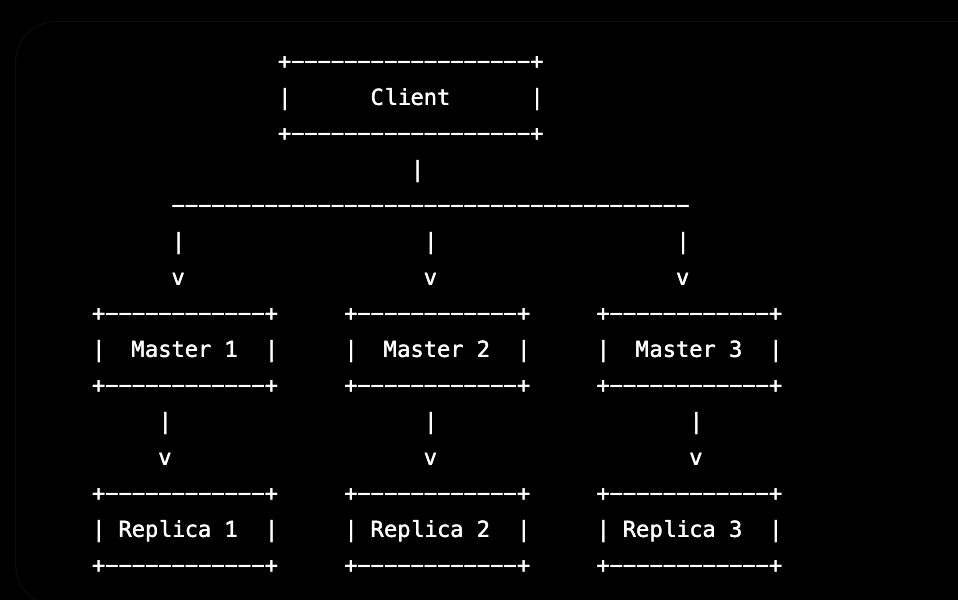
3.1. Master Nodes
Master nodes:
- store actual data,
- handle read/write requests,
- own a subset of hash slots.
Examples:
Master 1 -> slots 0 - 5460 Master 2 -> slots 5461 - 10922 Master 3 -> slots 10923 - 16383
3.2. Replica Nodes
Replica nodes:
- copy data from masters,
- provide backup,
- can replace failed masters.
If a master crashes:
Replica -> promoted to Master
4. Compare with Redis Senitel and Redis Cluster
-
Redis Senitel: HA.
-
Redis Cluster: sharding.
5. Persistence
Persistence refers to the writing of data to durable storage, such as a solid-state disk (SSD)
-
RDB (Redis Database): RDB persistence performs point-in-time snapshots of your dataset at specified intervals.
- For instance you may want to archive your RDB files every hour for the latest 24 hours, and to save an RDB snapshot every day for 30 days.
-
AOF (Append Only File): AOF persistence logs every write operation received by the server.
-
No persistence: You can disable persistence completely. This is sometimes used when caching.
-
RDB + AOF: You can also combine both AOF and RDB in the same instance.
6. Replications
-
1 master = N replicas
-
asynchronous replica: master-slave.
-
Read-only replicas
7. Security
7.1. ACL
7.2. TLS
8. Optimization
8.1. Benchmark
SET: 180180.17 requests per second, p50=0.143 msec
LPUSH: 188323.91 requests per second, p50=0.135 msec
8.2. CPU Profilling
8.3. Latency diagnosis
- Explain the query patterns.