



Computer Science Knowledge
Here is solutions for Framework Engineering - Computer Science.
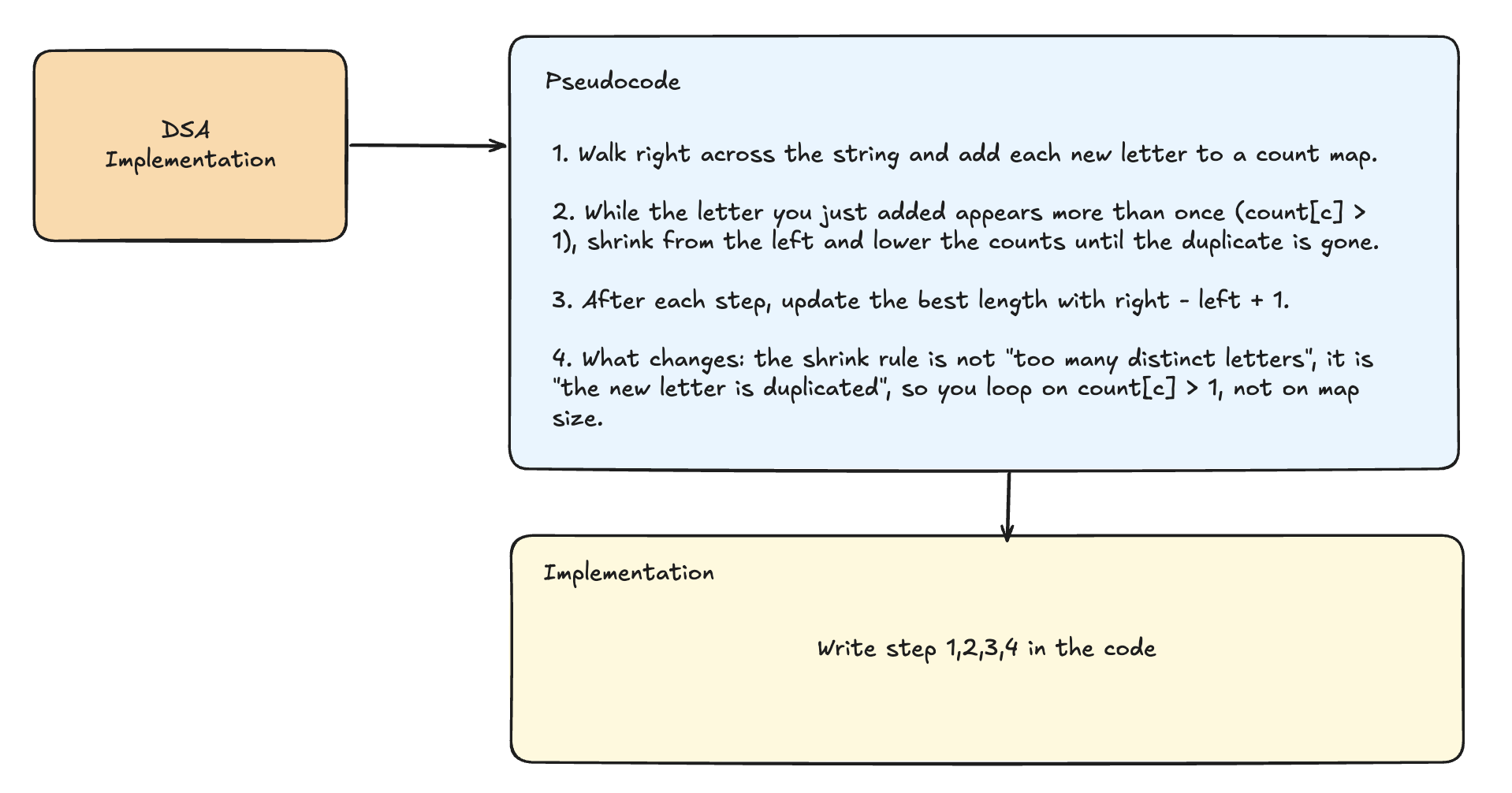
1. How to implementation ? - Pattern Oriented
- Optimize idea: Brute Force first → Optimize in ideas
- Use patterns for implementation ⇒ You good at idea, but stuck in implementation because you do not remember patterns.
2. Computer Architecture Knowledge
- CPU Cycle
- Mỗi CPU nó ping theo block
Cycle time = 1 / f- 2 GHz CPU → 1 cycle = 0.5 ns
- 4 GHz CPU → 1 cycle = 0.25 ns
- Mỗi CPU nó ping theo block
- Stall/Hazards
- Stall
lw r1, 0(r2) add r3, r1, r4- Cycle 1: lw in EX
- Cycle 2: lw in MEM (data not ready yet)
- Cycle 3: add wants r1 → NOT READY ⇒ Add stall here
- Hazards:
- Hazard causes a stall, but a stall is the result.
- Data hazard:
addneedsr1lwhasn’t finished yet
- Control hazard
if (x > 0) { A(); } - Structural hazard
| Cycle | IF | ID | EX | MEM | WB |
| —– | ——– | — | — | — | — |
| 1 | lw | | | | |
| 2 | add | lw | | | |
| 3 | ❌ stall | add | lw | | |
| 4 | next | ❌ | add | lw | |
| 5 | | | ❌ | add | lw |
- Cycle 3:
- lw needs data memory (MEM)
- add needs instruction memory (IF)
- Cycle 3:
- Data hazard:
- Hazard causes a stall, but a stall is the result.
- Stall
-
Struct Padding and Init by 32-bit (4 bytes), 64-bit (8 bytes) padding
-
Based on architect: 32-bit or 64-bit, so it store the padding of the OS differently ⇒ But need to divide by 4 bytes or 8 bytes like this.
struct Good { int i; // 4 bytes char c; // 1 byte char d; // 1 byte }; i -> 4 bytes c -> 1 byte d -> 1 byte pad -> 2 bytes Total: 8 bytes -
The compier maybe re-order the struct for better init padding, or aware about the memory address.
-
- SQL Parser

5. Network
- TCP 3-way handshaking ?
- Client sent SYN packet to the server with sequence num A
- Server sends SYN-ACK packet to the client with rand sequence num B and ack num A’ = A+1
- Client sends ACK packet to the server, with ack num B’ = B+1 and the sequence number is A’ ( the ack num it received in step 2)
- Why 3-way handshaking but not 2-way handshaking ?
- 2-way will establish a half-duplex connection: client → server.
- 3 way is full-duplex transaction: server → client.
- What is syn, ack mean?
- Syn means synchronizaton: SYN packet is sent when the sender tries to connect to the receiver.
- Ack means acknowledgment: ACK packet is sent by the receiver to the sender to help the sender know that the SYN packet that it sent before reached the destination successfully.
- Sequence numbers: 32 bit, value 2^32 - 1
- So if the amount of data is greater than 4GB, at least one sequence number value will be reused.
- What if the 3rd handshake fail? How the server can detect it and what does it do in this case?
- Based on ack number ⇒ Know what message in range [1000, 30000] is missing.
- Retry and back propagation ⇒ Dynamic retry based on Round-Trip Time (RTT)
- Checksum: Check source IP, destination IP, payload
- Sequence and byte-range: know the missing packet.
- How TCP close the connection?
- 4-way handshaking
- Step 1: Client send FIN
- Step 2: Server accept
- Step 3: Server send FIN
- Step 4: Client accept.
- How Ping command works?
- Calculate RTT based on when ping and receive message.
- What is TTL? How does TTL will be changed?
- To make sure the packet do not stuck forever in the Internet.
- Default TTL = 64, after reach the router TTL minus 1 ⇒ If it is 0, it is discard, send ICMP to the sender.
- HTTP Protocol
- Add some header fields: Method, POST, PUT, GET.
- Add cookie to the cookie.
- Session is generated in layer 6 with session ID, end when you kill the tab. AJAX technique?
- AJAX technique?
- A for asynchronous.
- Make API call without reload the page.
- OSI Model
- L7: Browser creates HTTP request - Application layer
- L6: Data is encrypted using TLS, encode JSON, UTF-8
- L5: Session is established - Server know which client is - Keeps the connection alive. Use session_id to stateful in browser => auto gen.
- L4: Data is segmented into TCP packets
- L3: IP address is added
- L2: MAC address is added, ARP protocol (Address Resolution Protocol) - You only find the MAC address of the next hop (your router).
- L1: Bits are transmitted over the cable
- DNS lookup (in case you already access google.com before and also in case you do not know the IP of google.com)
- Find in root DNS server ⇒ .com, .net,…
- Find top level domain
- Find authorized server.
-
Maximum port
- Source port: 16 bit.
- Destination port: 16 bit.
- Source IP, Destination IP: 32 bit.
- Total socket connection: 2^16 - 1
a . b . c . d 8 bits 8 bits 8 bits 8 bits => 28=256⇒0 to 255 - Socket
- When TCP connection is establish.
- It create a socket connect to connect between 2 server.
- Client: random port, Server: port 80
  Client: 192.168.1.10:53422
  Server: 93.184.216.34:80
- Do 2 processes same socket ?
- It’s ok, and this is call multi cast.
- IP and MAC Address:
- IP: tell who we will send data.
- MAC: how the data transfer through router.
- What is buffer? why we always need buffer when working with “file”?
- When the process is processed, store this in the buffer of the memory.
6. OS
- Process and Thread
- Process: independent program loaded to CPU.
- Thread: a single unit execution in the process
- Context switch in process and thread
- Context switch in process stored in PCB.
- Context switch in thread stored in TCB.
- But context switch in thread required ⇒ Page replacement, or page swap
- Virtual memory
- When a program load to memory ⇒ load to virtual memory
- Virtual memory = 8GB RAM + 16 GB Disk.
- Two process can access through the same physical address ?
- Yes, if virtual memory point to the same physical address.
- Process has how many states? How does it change between each state?
- Process have 5 states: new, ready, running, wait, and terminate
- PCB contains something: variable, memory, next command to process.
- Can two processes communicate with each other ?
- Shared memory or message passing
- What is child-process? How to create a child-process?
- Child process is copy-on-write from parent.
- But it is independent process, only communicate with parent through shared memory and message passing.
- Deadlock
- Mutual exclusion: access same resource.
- Hold and wait: each process hold, other need to wait.
- No preemption: wait too long to execute.
- Circular wait
- CPU Algorithm scheduling
- FCFS, SJF, Round-robin, SRJF, Priority Queue
- Mutex, Semaphore, Read-write lock
- Mutex: access same resource.
- Semaphore: limit of resource pool.
- Read-write lock:
- Write lock: Only one thread can hold it, when write lock all.
- Read lock: do not lock.
- What process data contains:
- Text section: code
- Data section: global and static variable.
- Stack section: local variable
- Heap section: dynamic allocation variable or object.
-
File description in Linux
FD Meaning 0stdin (keyboard) 1stdout (terminal output) 2stderr (error output) -
User mode, kernel mode, system call
- User mode: only access user data, limit some permissions like i/o modify file system.
- Kernel mode: Can do all things.
-
System call: change from user mode to kernel mode.
  ls

  Multiple syscall: openat() -> getdents64() -> ...
- File system in Linux
- Regular File
- Directory
- Pipe: process intercommunication
- Socket: from host to internet.
- Device Files
- Garbage collector
- Each language have this
- Idea of Java is: Young Generation, Old Generation, Adult Generation, Permanent Generation
7. Database
- 3 types of normalize data
- Type 1: Each field 1 value.
- Type 2: Split table for PK → A, PK → B,…
- Type 3: Split table B → C, B → D ⇒ Split B → C, B → D, although B is not PK
- Dirty read, Non-repeatable read, Phantom read
- Dirty read: read the value uncommited.
- Non-repeatable read: in the same transaction, have 2 different value when different transaction have committed.
- Phantom read: Same query but query again have value
- 4 isolation level
- Read uncommited
- Read committed: solve dirty read.
- Non-repeatable read: solve repeatable read.å
- Serializatable: solve phantom read too.
December 16, 2025